
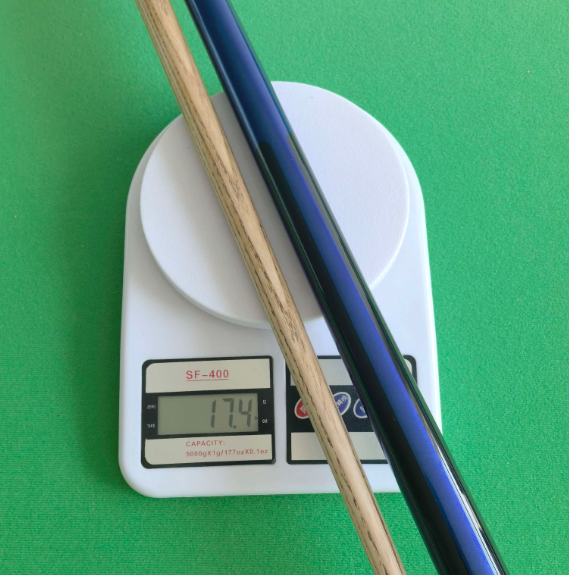
A snooker cue — often called a “small-tip cue” — differs significantly from a pool cue (American cue) in length, weight, and playing style. Snooker cues are shorter and lighter, with a typical tip diameter of just 9–10mm, making them ideal for precise positional play and delicate cue ball control.
So, what is the best weight when choosing a snooker cue?
The short answer: there is no single “perfect” weight, but 17.5–18.5 oz (approx. 495–525g) is the mainstream sweet spot — with 18–18.5 oz being the most popular comfort zone.
There is no single “perfect” weight, but 17.5–18.5 oz (approx. 495–525g) is the mainstream sweet spot — with 18–18.5 oz being the most popular comfort zone.
Choose by Skill Level & Playing Style
| Player Type | Recommended Weight | Why |
| Beginners | 18–19 oz | A slightly heavier cue provides more natural inertia, helping keep the stroke straight and building consistent habits |
| Intermediate · Power Players | 18.5–19 oz | Players who favor strong shots and accuracy will appreciate the solid, stable feel and confident cue ball control |
| Intermediate · Finesse Players | 17–17.5 oz | Players who rely on spin, touch shots, and delicate position play benefit from a lighter cue’s agility and reduced wrist strain |
Pro References: Ronnie O’Sullivan ~18 oz, Liang Wenbo 18.1 oz, Zhao Xintong ~17.5 oz — all sitting comfortably within the 17.5–18.5 oz gold zone.
What to avoid:Under 16 oz Too Light ,Light cues demand exceptional stroke straightness; even minor flaws are amplified. Not recommended for beginners;Over 20 oz Too Heavy, Causes wrist and arm fatigue during long sessions, and noticeably reduces finesse on delicate shots like screw shots or thin cuts.
Balance Point Matters More Than Weight
Many buyers focus only on total weight, but balance point is just as critical — two cues with identical weights can feel completely different in your hands:
- Front-heavy (balance point toward tip) → Feels more powerful and penetrating; ideal for players who like a solid hit
- Rear-heavy (balance point toward butt) → Feels quicker and more agile; ideal for fast, repetitive stroking
How to Test a Cue
No matter the specs, feel is everything. When testing a cue, remember these three checks:
- Forearm doesn’t tire when hanging naturally — the weight matches your arm strengt
- Wrist stays steady through multiple shots — the balance point suits your grip
- No need to force extra power on the stroke — the cue works with you, not against you
In short, A good cue is one that feels comfortable in your hands and lets your stroke flow naturally.