
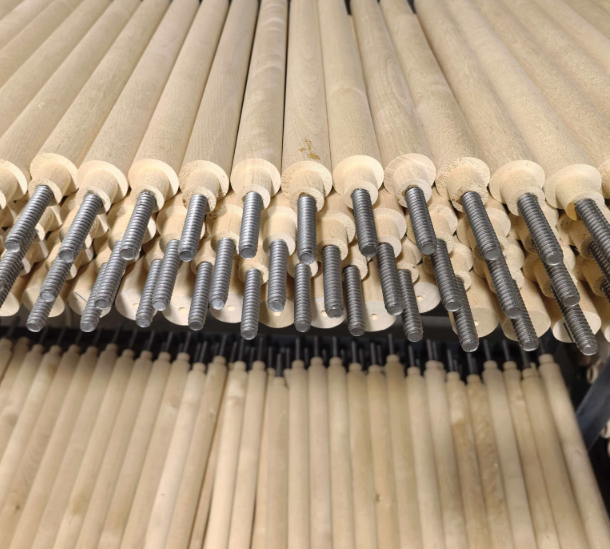
You’ve seen the finished product—a sleek, high-performance cue that delivers a perfect hit and stays straight for years. But have you ever wondered what goes on behind the scenes? In our factory, crafting a premium split cue (like a 9-ball ) involves 30 to 50 meticulous steps. Today, we are pulling back the curtain to show you a simple yet crucial auxiliary tool: the wooden handle you see in the image.
What is it?
This isn’t part of the final cue you play with. It’s a specialized auxiliary handle used during the manufacturing process. If you look closely at the image, you’ll see rows of bare cue butts with metal joint screws ( joint pin) pre-installed. This wooden handle is designed to screw perfectly into those metal joints.
Its Critical Role in Production
One of the most vital steps in cue making is bonding the joint collar (or “Butt cap”) and the intermediate joint (or “middle wheel”) to the wooden butt. We use high-strength adhesives to ensure a permanent, solid connection. However, these adhesives need time to cure.
During this curing period, any movement or misalignment can ruin the cue’s structure and affect the hit. That’s where our wooden auxiliary handle comes in. We screw it into the joint to act as a temporary clamp, holding the butt and the joint collar firmly in place.
Once the glue is completely dry and set, we simply unscrew this auxiliary handle and set it aside, ready to be used for the next batch. This process is repeated for both the rear joint and the intermediate joint, using handles with corresponding specifications.
The Obright Standard
At Obright Custom Cue Factory, we believe a perfect cue is the sum of its details. This simple wooden handle is a testament to our commitment to precision and stability. It ensures that every joint is perfectly aligned and securely bonded, which is essential for flawless power transmission and a consistent feel.
Every cue maker here operates with a true artisan spirit, orchestrating a masterpiece with every single detail.