
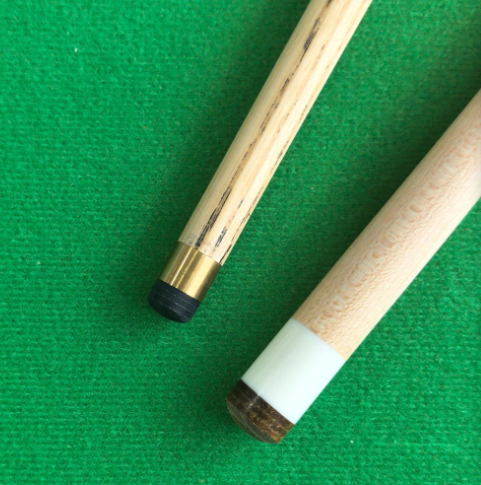
Snooker and American pool are the two most popular cue sports worldwide. While their cue structures share the same basic components, there are significant differences in design details. Understanding these distinctions not only helps you master the techniques of each game more quickly, but also guides you toward choosing the cue that best fits your playing style. Today, Obright Cue Factory breaks down the key similarities and differences between snooker and pool cues—see the comparison table below 👇
| Feature | Snooker Cue | American Pool Cue |
| TiP | Single or multi-layer leather (mostly 9~10.5mm, some 11mm). Generally softer to facilitate precise control and spin. | Single or multi-layer leather (mostly 12~13mm, some 11.5mm). Hardness varies (soft/medium/hard) for higher forgiveness and powerful breaks. |
| Ferrule | Typically made of brass or other hard metals. Protects the shaft and delivers crisp feedback. | Usually dual-density phenolic (often called linen-phenolic or carbon fiber composite). Highly durable, absorbs impact, and reduces deflection. |
| Shaft | Primarily Ash wood, featuring clear straight grains (often arrow-shaped), offering good elasticity and delicate feedback. High-end models may use Maple. | Mostly Hard Rock Maple with tight, uniform grains. Very hard, providing direct power transfer. Modern cues often feature carbon fiber shafts (low deflection). |
| Butt | Constructed from various woods (e.g., Ebony, Rosewood, Maple) with spliced decorative points. Designs are relatively simple. | Maple or exotic woods (e.g., Ebony, Rosewood) with complex splices, often featuring intricate inlays (shell, abalone, or micarta). Butts are generally thicker. |
| Bumper | Rubber or metal (often a brass butt cap, sometimes paired with a badge inlay at the base). | Rubber or plastic/metal butt cap. The base is usually flat without a notch, and some feature adjustable weight bolts. |
| Construction | 1-piece (full splice), 3/4 split (butt unscrews), or occasionally 2-piece (custom). | 2-piece (standard 1/2 split, joint located at the center of the cue for easy transport). |
| Length | Typically 145~147cm (57~58 inches). Longer shafts accommodate the larger snooker table. | Typically 147~148cm (58~59 inches). Proportions are generally thicker and sturdier. |
| Weight | Lighter, usually 17~19oz (approx. 480~540g), ideal for delicate control. | Heavier, usually 19~22oz (approx. 540~620g), suited for power shots and long-distance play. |
| Grip | Usually a smooth wood finish or light wrap. The grip is slimmer for a close, fitted feel. | Often fe9-ball, 8-ball (larger balls). Emphasizes power, high forgiveness, and heavy spin.atures a dark wrap (linen, leather) or rubber grip. The grip is thicker for stable power delivery. |
| Best For | Snooker, Chinese 8-ball (small balls). Emphasizes accuracy, precise position play, and spin. | 9-ball, 8-ball (larger balls). Emphasizes power, high forgiveness, and heavy spin. |