
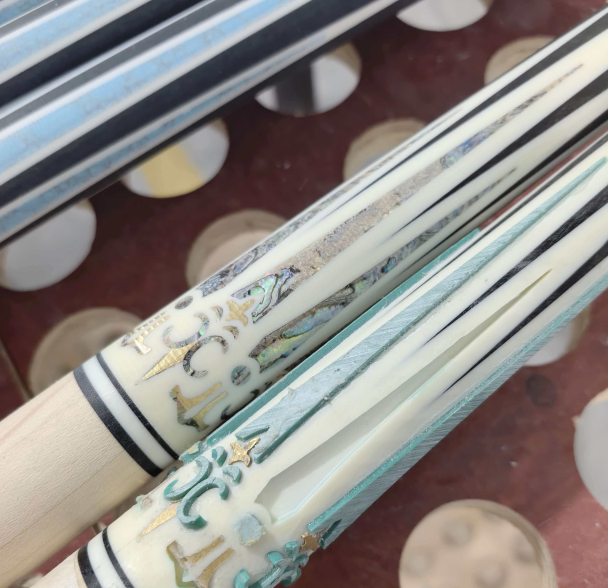
When it comes to custom pool cues, the devil is in the details. Beyond the wood grain and the taper, it’s the **inlay craftsmanship** that transforms a simple tool into a work of art. Techniques such as splicing, shell inlay, and wire inlay require extreme precision and are primarily used in the joints between the butt and the collar, as well as for overall decoration.
At Obright Cue Factory, these techniques are staples of our custom handcrafted cues, significantly boosting both their personalization and value. Here is a breakdown of the technical characteristics of each process.
1. Splicing (Wood Inlay)
Splicing is the foundation of cue aesthetics. This method involves inserting meticulously shaped pieces of **exotic woods** (such as ebony, purpleheart, or bocote) into the cue butt according to a pre-designed pattern.
Why it matters:Splicing adds visual depth and layering. It breaks up the monotony of a single wood type, ensuring that every cue possesses a unique aesthetic appeal and structural integrity.
2. Shell Inlay (Mother-of-Pearl & Abalone)
Shell inlay is perhaps the most iconic form of cue decoration. It involves embedding finely cut and polished pieces of **mother-of-pearl or abalone** into the cue surface.
Why it matters: Because no two shells are identical, this craft ensures that each cue is one-of-a-kind. The iridescent glow of the shell catches the light, dramatically enhancing the artistic value and prestige of the cue.
3. Wire Inlay (Silver Ring / Filigree)
Often referred to as “silver rings” or “filigree,” this technique uses special carving and polishing methods to embed fine metal wires (typically silver or brass) into the cue surface.
Why it matters:This creates crisp, intricate lines with a metallic luster. Beyond aesthetics, a well-executed wire inlay provides a subtle textural contrast, giving the cue a smooth yet distinctive grip feel.
4. Material Inlay (Metal, Gemstone & Resin)
For the ultimate in customization, material inlay utilizes diverse elements—such as **metals, gemstones, and resins**. These are embedded into specific areas of the cue according to complex patterns.
Why it matters: This process demands the highest levels of precision. It allows for bold, modern designs that stand out, catering to players looking for a truly bespoke instrument.
Whether you prefer the classic elegance of wood splicing or the flash of abalone, inlays are what make a cue personal. At Obright, we combine traditional hand-skills with modern precision to bring these visions to life.
Ready to create your own masterpiece?