
In the European and American markets, the two-piece (2pc) pool cues we regularly supply from Obright Cue Factory share highly similar core structures and craftsmanship standards.
The shaft is typically made of either carbon fiber or maple. Carbon shafts feature a sleek, solid black finish, while maple shafts retain their natural tone—showcasing organic patterns like tiger stripes or flame grain—delivering both visual appeal and easy on-table identification.
For the butt section, while premium lines use rare/exotic woods, our high-volume, cost-effective cues utilize maple, birch, or maple sleeves. Because they are built from the same prototype and factory standards, the baseline playability and construction are consistent. The real differentiator lies in the butt decoration method: printing or Water Transfer Printing,carving or splicing, and inlay work. These processes directly determine the cue’s added value and market positioning.
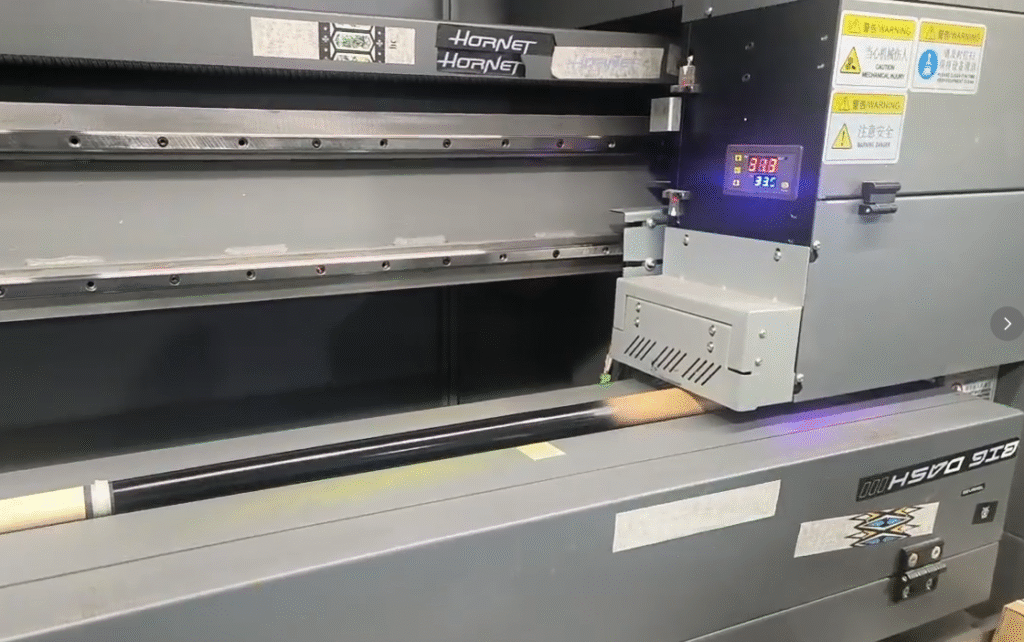
Today, we’re taking you to one corner of our production floor for a close look at UV printing technology in modern cue manufacturing in China:
So, why choose UV printing over traditional methods like pad printing or hand-painting? There are three key advantages: Precision, Durability, and Flexibility.
Unlike solvent-based inks that air-dry and fade over time, UV printing uses ultraviolet light to instantly cure the ink. As you can see in the photo, the machine applies the graphics with microscopic accuracy. This means we can reproduce intricate logos, photorealistic images, and complex geometric patterns directly onto the curved surface of the cue butt—or even the shaft—without blurring or misalignment.
Furthermore, the cured ink forms a micro-thin protective layer. It is highly resistant to scratches, chipping, and the oils from players’ hands. For distributors and brands, this technology offers unparalleled flexibility; it supports low minimum order quantities (MOQs) for custom branding, allowing you to test new designs in the market without the massive upfront investment required for traditional inlays or splices.