
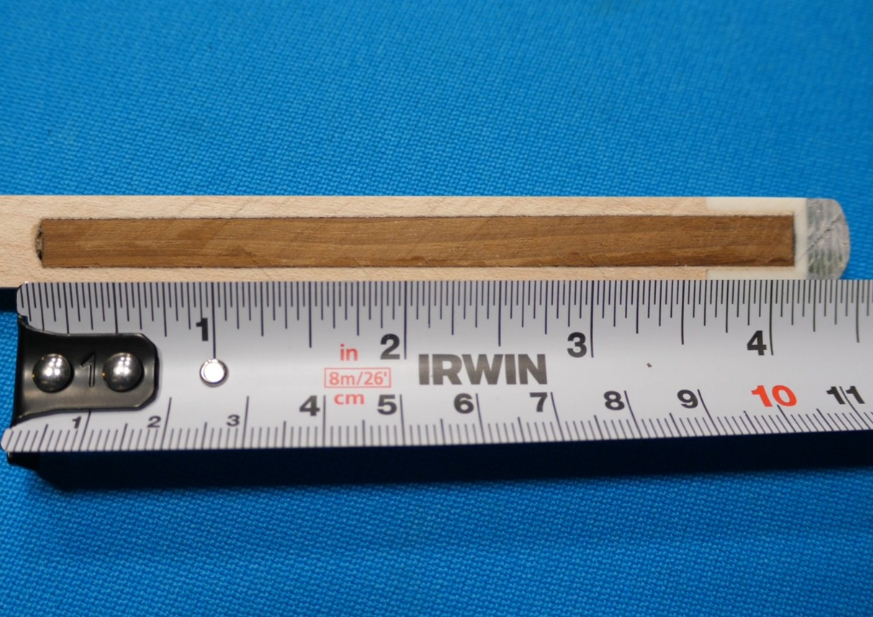
In the world of mid-to-high-end cue manufacturing, brands constantly explore composite structures to balance hit feel and physical performance. Recently, Obright Cue Factory undertook an OEM order from a Canadian client requiring a highly challenging process: axially embedding an ultra-thin carbonized wood core into a traditional North American Hard Rock Maple shaft.
This wasn’t just a production run; it was a stress test of our precision machining capabilities. Today, we break down the technical hurdles and the solutions we engineered to overcome them.
1. What is Carbonized Wood?
Simply put, carbonized wood is wood that has undergone a “trial by fire.”
The selected North American Hard Rock Maple or Ash is placed in a sealed, oxygen-deprived environment and heated to 160°C–230°C for several hours—a process known as Thermal Modification:
Chemical Transformation: The hemicellulose degrades, significantly reducing hydrophilic groups (hydroxyls) within the wood.
Performance Boost: Water absorption drops by approximately 50%, hardness increases substantially, dimensional stability improves dramatically, and the wood takes on a rich, dark chocolate hue.
This material solves the common issue of standard maple warping due to humidity fluctuations, making it an ideal reinforcement for premium shafts.
2. The Challenge: Walking a Tightrope with 6″ x 8mm Dimensions

The specification required embedding a carbonized wood core measuring 6 inches (150mm) long with an 8mm diameter into the center of the maple shaft. While it sounds simple—just drill and insert—the reality was fraught with difficulties:
Brittleness: Carbonization increases hardness but also brittleness. Handling a 150mm-long rod with an 8mm diameter without snapping it required extreme care. In contrast, our previous experience with inserting flexible carbon fiber tubes yielded much higher success rates.
Concentricity: The core had to enter precisely through the center of the ferrule. Any deviation from the axis would ruin the shaft’s dynamic balance, causing a noticeable “wobble” during play.
Interference Fit: The fit had to be perfectly tight. Any micro-gap would compromise energy transfer and structural integrity.
3. Obright’s Technical Solution: Precision Drilling & Flexible Guidance System
Faced with this delicate task, our engineering team developed a refined Standard Operating Procedure (SOP) after multiple rounds of prototyping:
Step 1: Step-Drilling (Pilot Drilling)
To prevent the bit from wandering or crushing the core under friction heat, we abandoned the “drill-through” method.
Process: Using custom extra-long hardened twist drills, we employed a step-drilling technique. We started with a small pilot hole and gradually increased the bit diameter until reaching the final 8mm bore.
Lubrication: Specialized wood wax oil was used throughout to lubricate and cool the bit, preventing thermal degradation of the wood fibers.
Step 2: Custom Guide Bushing
This was the key innovation that solved the breakage issue.
Process: We designed a high-precision brass guide bushing. During insertion, this sleeve supports the mid-to-rear section of the wooden core, providing lateral stability and preventing buckling or snapping under pressure or gravity.
Result: This tooling reduced the scrap rate from an initial 40% to less than 5%.
Step 3: Pressure Injection & Vacuum Degassing
To ensure zero looseness, we utilized a specialized bonding process.
Process: A high-penetration flexible epoxy was selected. After injection, a vacuum process removed all trapped air, ensuring the adhesive filled every microscopic gap between the core and the maple shaft. Once cured, the bond became molecular-level.
Step 4: Curing & Stress Relief
Process: Post-bonding, the shafts were left to cure for 12 hours in a controlled environment (45°C, constant humidity). They then underwent secondary turning to remove excess glue and a 48-hour stress-relief period to guarantee the shaft remains straight during use.
4. Performance Advantages of the Finished Product
This rigorous process resulted in a shaft with significantly enhanced characteristics:
Ultimate Stiffness: Acting like a “backbone,” the carbonized core drastically increases longitudinal stiffness, minimizing deflection during powerful shots.
Weather Resistance: Thanks to the low hygroscopicity of carbonized wood, these cues are exceptionally stable in Canada’s dry winters and humid summers.
Feedback & Feel: Unlike metal or carbon fiber, this wood-on-wood structure preserves the signature “soft touch” of maple while enhancing the clarity of power feedback.
At Obright Billiard cue Manufacturer in China, every cue is viewed as a craftsmanship . This project for our Canadian client reaffirms our expertise in dissimilar material composite processing. If you have innovative ideas regarding cue construction, we invite you to collaborate with us. We offer comprehensive support from sampling to bulk production.