
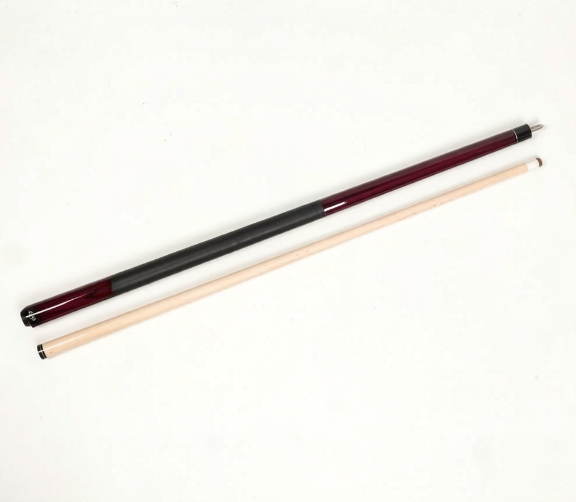
Cue sticks range from budget-friendly to high-end, yet their structures are largely uniform. The primary distinctions lie in the materials used and the craftsmanship involved. For beginners, there is no need to invest in an expensive cue; one priced at a few hundred RMB will suffice. Below, we outline the anatomy of a cue stick.
From tip to butt, a cue consists of the following components: the Tip,the Ferrule, the Shaft, the Joint , the Butt, and the Butt Cap:
- Tip: This is the sole point of contact between the billiard pool cue and the billiard ball. Tips come in various sizes—9mm, 9.5mm, 10mm, 11.5mm, and 13mm—and varying degrees of hardness: hard, medium, and soft. Different tips offer distinct feel and grip on the ball, affecting spin and power. You’ll develop a preference as you gain experience.
- Shaft: The front portion of the cue, which demands straightness and a degree of elasticity for optimal performance.
- Joint:This component is specific to 2pc or 3/4pc cues; 1pc cues lack this feature. A quality joint ensures a seamless connection that does not interfere with your stroke,transparent force transmission.
- Butt: The area where you grip the cue. It can be finished with leather wrap, linen wrap or wrapless. Factors like sweaty hands or palm size often dictate the choice of butt configuration.
- Butt Cap: Located at the very end of the cue, it houses counterweights and features a connector for attaching an extension.