
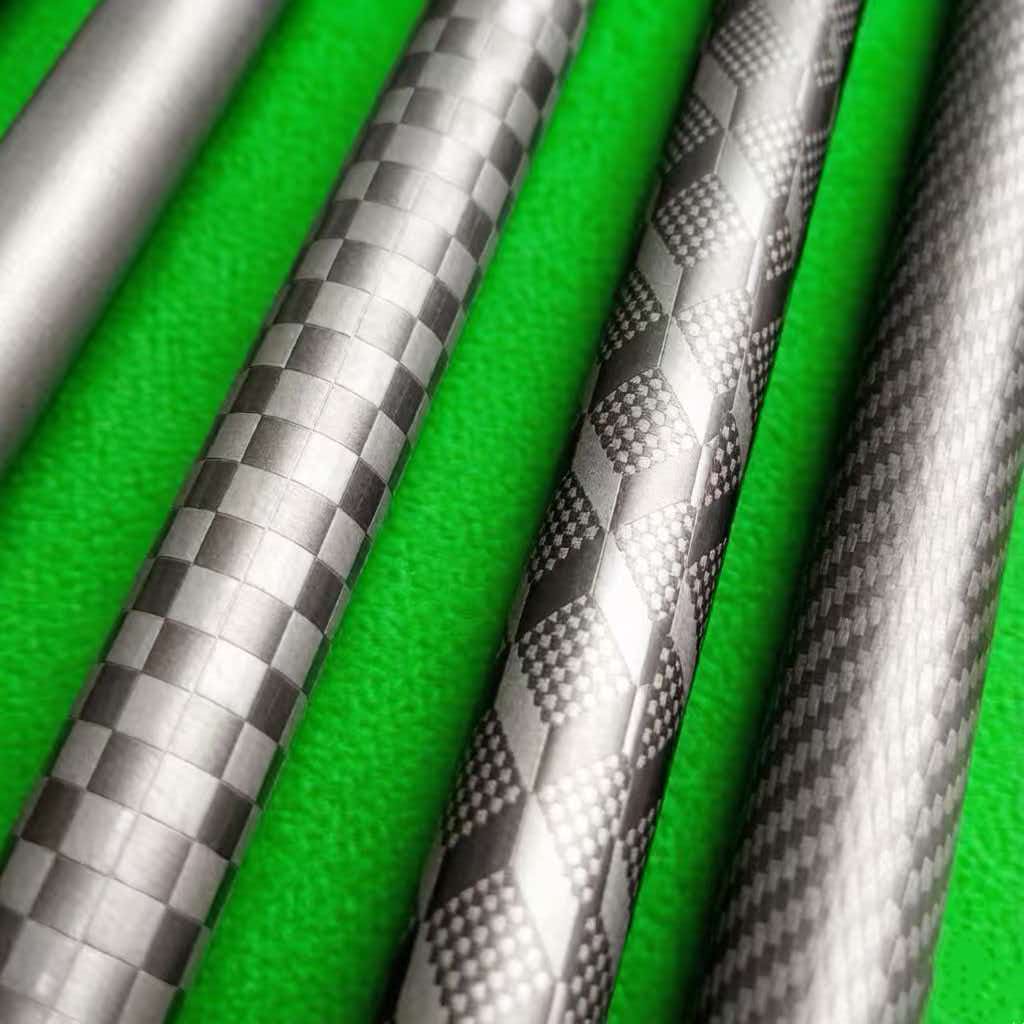
At our factory, we previously partnered with a US-based billiard brand to produce a 200-piece custom carbon fiber cue order across four distinct styles. You can view the finished bulk production details here(3K W Symboles All Carbon FIber Cue – Chongqing Obright Company).
While the order volume was standard, the technical specifications were anything but. The client requested a configuration that pushed the boundaries of standard manufacturing: a 30.5-inch carbon fiber shaft weighing 9 oz, paired with a butt section weighing only 6–8 oz—despite a mandated wall thickness of 2mm.
To put this into perspective: Industry benchmarks like the Predator REVO or Cuetec Cynergy feature carbon shafts weighing around 3.5–4 oz, with their butt sections typically tipping the scales at 10–12 oz. Achieving a 6–8 oz butt is considered an ultra-light, competition-grade specification, reserved for elite custom builds.
So, how did our engineering team crack the code? Through rigorous R&D and iterative testing, The lightest achievable weight for this specification is 8 oz ± 0.5 oz. Following discussions and confirmation with the client, we aligned on a final production weight of 8 oz ± 0.5 oz for the bulk order.Below are the key points of our manufacturing process.
1. Precision Thin-Wall Mandrel Winding
The foundation of the weight reduction started with the core structure. Instead of standard molding, we utilized high-precision steel mandrels to wind aerospace-grade T700/T800 carbon fiber prepreg.
- The Challenge: Maintaining structural integrity with a strict 2mm wall thickness.
- Our Solution: We optimized the fiber-to-resin ratio during the curing process. By minimizing excess epoxy (the heaviest part of the composite), we ensured the 2mm walls remained stiff enough to prevent “wobbling” or “dead spots” during play, without adding unnecessary mass.
2. High-Strength Composite Joint System
Traditional cues use stainless steel or brass joint collars, which can add 30–50g of dead weight. To hit the 6–8 oz target, metal was not an option.
- The Innovation: We engineered a carbon-fiber-reinforced polymer (CFRP) joint system.
- The Result: By developing a threaded insert made from high-tensile carbon composites, we eliminated heavy metals while ensuring the threads could withstand repeated assembly and torque without stripping. This single change saved approximately 1–1.5 oz.
3. Minimalist Butt Cap
Every gram counts in ultra-light engineering. We moved away from heavy rubber bumpers.
- Hardware: We replaced standard rubber bumpers with precision-machined Delrin (POM) caps, which offer high impact resistance at a fraction of the weight.
4. Dynamic Balance Optimization
Because the butt was so light, we had to ensure the cue didn’t feel “front-heavy.”
- Internal Structure: We kept the core hollow but utilized micro-foam injection at specific nodal points inside the butt. This prevented internal rattling and fine-tuned the center of gravity without resorting to lead weights.This project demonstrates our capability to move beyond standard “off-the-shelf” manufacturing. Whether you require specific swing weights, unique balance points, or extreme lightweight configurations for professional players, our R&D team has the expertise to turn complex specifications into high-performance reality. Looking for a custom cue manufacturer that handles the difficult specs?
Contact us today to discuss your project or request a sample based on your unique requirements.
Pro Tip for Buyers: When sourcing ultra-light cues, always confirm the wall thickness tolerance. Thinner isn’t always better if the resin content isn’t controlled—our vacuum-assisted curing process ensures consistency across all 200 units.