
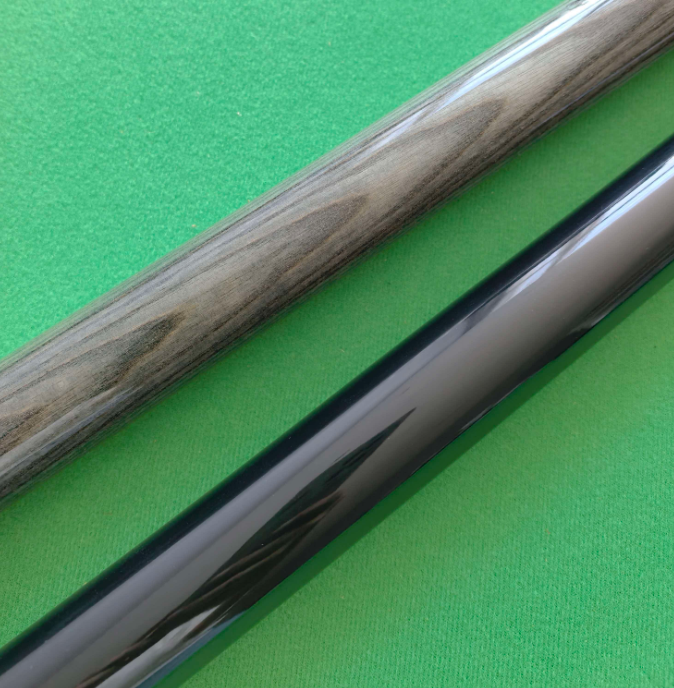
When developing your brand’s pool cue product line, the design of the butt section is often the key to showcasing brand identity and capturing a player’s attention. For clients seeking OEM/ODM customization services, the first step toward achieving rich patterns usually lies in choosing between Staining and Painting during substrate processing.
These two processes not only affect the final appearance of the cue but also directly impact its feel, durability, and cost. This article will provide an in-depth analysis of the pros and cons of staining versus painting wooden cues, helping you make the wisest decision during factory sampling.
I. What is the Staining Process?
Staining involves penetrating dyes into the interior of the wood to alter its natural color while preserving the wood’s natural grain.
✅ Pros:
- Natural Wood Grain: This is the greatest charm of staining. The dye penetrates along the grain, presenting a deep, translucent texture that looks premium, classic, and natural. (As shown in our American Maple Cues: http://site.ntesmail.com/s34af1a3853e545/en/products/American-Maple-Cues-1.html)
- Warm Touch: Stained wood maintains its original warm touch, unlike cold plastic, meeting the quality demands of experienced players.
- Durable: Since the dye integrates with the wood, it is resistant to daily friction and retains its color over long-term use.
- Eco-friendly: Compared to chemical paints, high-quality wood dyes are generally more environmentally friendly and odorless.
❌ Cons:
- Limited Color Palette: Restricted by the wood’s density, some light colors (like light green or gray) do not show ideal results and may appear lacking in texture.
- High Raw Material Demand: If the wood itself has messy grain or slight defects, staining will expose them entirely. High-grade wood (such as Ash or Maple) is required.
- Time-consuming: Requires multiple rounds of sanding, coloring, and drying, resulting in a relatively longer production cycle.
II. What is the Painting Process?
Painting involves spraying coating materials onto the wood surface to form a protective layer and color layer.
✅ Pros:
- Rich Colors & High Coverage: It can achieve any color you desire, including gradients and holographic effects, making it perfect for trendy, youth-oriented markets.
- Smooth Surface: The paint film perfectly conceals wood defects, providing an extremely flat, smooth, and silky touch, reducing the demand for wood grade.
- Excellent for Graphics: As shown in our Custom Jump Cues ,Shop Premium American Maple Cues for Unmatched Performance | High-Quality Billiard Cues for Professionals & Enthusiasts, the smooth painted surface is the perfect canvas for water slide decals or heat transfers, perfectly restoring complex floral and geometric patterns.
- Efficient Production: Mechanized automated spraying lines make it suitable for large-volume orders.
❌ Cons:
- Hides Wood Grain: It prioritizes color over texture, completely covering the natural beauty of the wood.
- Potential Odor: Paints may have a chemical smell affecting user experience; eco-friendly water-based paints are recommended.
- Risk of Chipping: In frequently bumped areas (like the joint), the paint layer has a slight risk of peeling off over long-term use.
- Common in Market: Due to mass mechanized production, high output makes it a very common sight in the market.
Factory Perspective: How to Choose?
As an experienced billiard cue supply chain, we recommend clients decide based on their target market and product positioning:
- Choose [Staining] if: You focus on retro, mid-to-high-end, and classic series; your target customers are experienced players who value feel and texture; you want to highlight the natural beauty of the wood.
- Choose [Painting] if: You target trendy, youthful markets; you need rich colors to match complex patterns (like decals and inlays); you pursue efficient production for bulk orders.
In fact, for many high-end custom models, we adopt a “Base Stain + Top Coat” hybrid process. This preserves the essence of the wood grain while achieving gorgeous colors, supplemented by exquisite water slide decorations (like the beautiful white floral patterns shown in the image), reaching the pinnacle of both visual appeal and tactile feel.
Customize Your Exclusive Cues
Whether you prefer the steady wood grain of staining or the gorgeous colors of painting, we provide professional OEM/ODM one-stop services. From material selection, design, sampling to mass production, our engineering team will provide you with the optimal process solutions.
👉 Contact our business advisor today to get the latest custom cue sampling plans and quotes!